How to make a practice test from your course notes
To make a practice test from your notes, copy the question types and topic weights from your syllabus, write questions only from material your course covered, and answer them closed-book under a time limit. Grade yourself against a marking guide, then study the questions you missed before trying a fresh set a few days later.
Why practice tests work
Recalling an answer strengthens memory more than reading it again. In a well-known experiment (Roediger and Karpicke, 2006), students who took a practice test on a passage remembered more of it a week later than students who spent the same time rereading it. The effect holds when you get questions wrong, as long as you check the right answer afterward.
Step 1: copy the real exam's format
Your syllabus usually says what the test looks like: how many questions, which types, how long you get, and which weeks count. Match it. A test of definitions won't prepare you for a case exam, and multiple choice won't prepare you for a proof.
| Question type | What it checks | Good for |
|---|---|---|
| Multiple choice | Recognizing the right idea among close options | Sciences, health, intro courses |
| Short answer | Recalling and explaining one idea | Most subjects |
| Problem or calculation | Applying a method step by step | Engineering, math, finance |
| Case or scenario | Choosing which idea applies and why | Business, law, health |
| Essay | Building an argument with evidence | Humanities, social sciences |
Step 2: write questions from your own notes
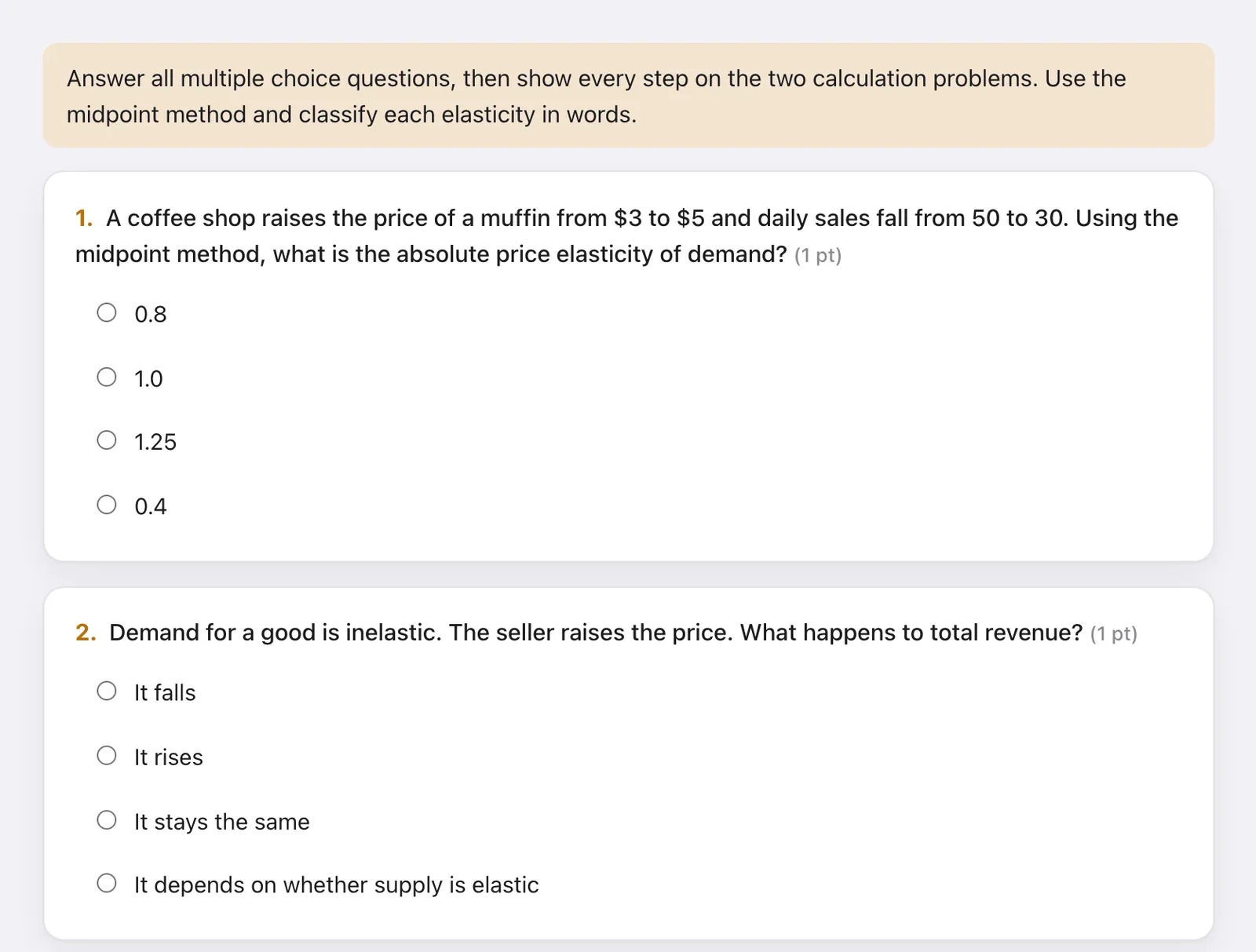
- Take each heading in your notes and write at least one question that needs it.
- Weight topics the way the syllabus does. If a week is a third of the grade, it gets a third of the questions.
- Mix easy recall questions with ones that ask you to apply an idea to something new.
- Write the answer and the marking points at the same time, so grading is honest later.
Step 3: take it like the real thing
Closed book, timed, phone away. Looking at notes mid-test turns recall back into rereading and wastes most of the benefit.
Step 4: grade it the way your professor would
Mark against the marking points, not a feeling. For written answers, check whether you named the concept, explained it, and applied it. The questions you missed are your study list for the next few days.
Step 5: space it out and repeat
Take a new set of questions a few days later, including topics you got right. Reviewing across separate days works better than one long session (Cepeda and colleagues, 2006).
Letting AI write and grade the test
An AI model can write a practice test in your exam's format if you give it your notes and the syllabus, and it can grade written answers with feedback. Ask it to keep to your course material, to match the question mix, and to explain each mark it takes off. Sendy Study Tool builds practice tests this way from every unit you upload and grades them with written feedback. For notes to build from, see how to turn lecture slides into study notes.
Sources
- Roediger, H. L., and Karpicke, J. D. (2006). Test-enhanced learning: taking memory tests improves long-term retention. Psychological Science, 17(3), 249-255. doi:10.1111/j.1467-9280.2006.01693.x
- Cepeda, N. J., Pashler, H., Vul, E., Wixted, J. T., and Rohrer, D. (2006). Distributed practice in verbal recall tasks. Psychological Bulletin, 132(3), 354-380. doi:10.1037/0033-2909.132.3.354
Questions students ask
Do practice tests actually help you study?
Yes. Taking a practice test is one of the best-supported study methods in learning research. Recalling an answer strengthens memory more than rereading the same page, even when you get the question wrong and check the answer afterward.
How many practice questions should I do before an exam?
Enough to cover every topic on the syllabus at least twice, spread over several days. Spacing the sessions out works better than doing them all the night before.
Can AI write a practice exam for my class?
Yes, if you give it your own notes and tell it the exam format from the syllabus. Ask for the same mix of question types as the real exam, and ask it to grade your answers with written feedback, not just a score.