Cornell notes: the method, an example and a faster way
Cornell notes split the page into three parts: a wide column for notes during the lecture, a narrow cue column for questions you add afterwards, and a summary at the bottom. The cue column turns the page into a self-test: cover the notes, answer each question from memory, then check. The method comes from Walter Pauk at Cornell University.
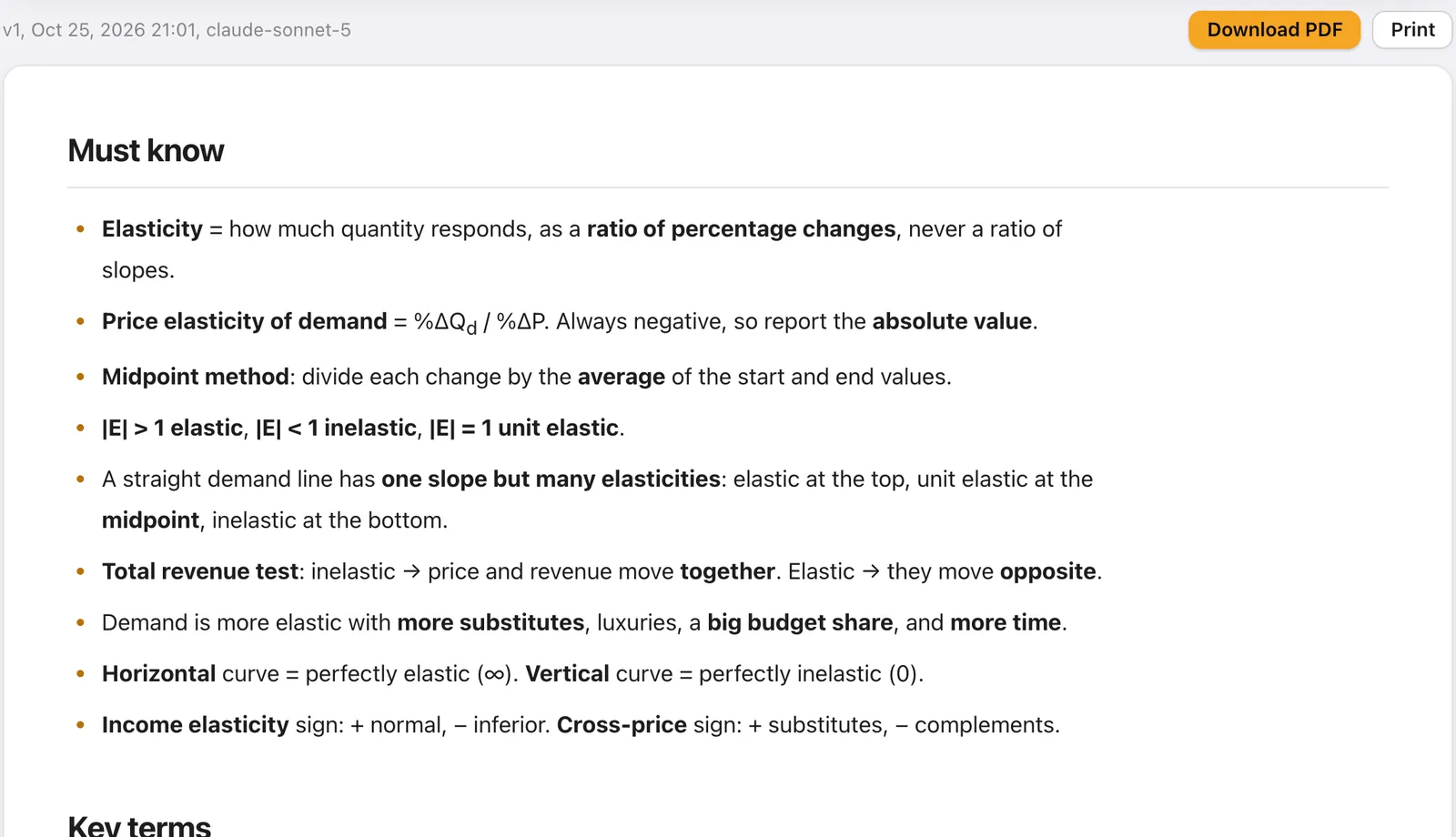
The layout
- Notes column, about two thirds of the width: what was said and shown, in short sentences.
- Cue column, the left third: questions and keywords you write after the lecture, one beside each chunk of notes.
- Summary, a few lines across the bottom: the page in your own words.
The method, step by step
- Record. During the lecture, write in the notes column. Skip what is already on the slides and capture the explanation and examples.
- Question. Within a day, write a question in the cue column for each chunk. "What does the midpoint method fix?" works better than "midpoint method".
- Recite. Cover the notes column and answer each cue out loud. This is the active recall step and the reason the method works.
- Reflect. Write the summary: what this page is about and how it connects to last week.
- Review. Repeat the recite step every few days, and before the exam.
An example
| Cue | Notes |
|---|---|
| Why use the midpoint method? | A percentage change from the start value differs going up and coming down. Dividing by the average of start and end gives the same elasticity both ways. |
| Is slope the same as elasticity? | No. A straight demand line has one slope but its elasticity changes: elastic at the top, unit elastic in the middle, inelastic at the bottom. |
| Inelastic demand and a price rise? | Total revenue rises, because quantity falls by a smaller percentage than price rises. |
Summary: elasticity compares percentage changes, so measure them with the midpoint method and never read it off the slope. Revenue rises with price only when demand is inelastic.
A faster way
Writing notes by hand during a fast lecture is hard, and the cue column is the step most students skip. One option is to let an AI note taker write the full notes from the slides, reading and recording, then spend your time on the part that matters: writing cue questions and reciting. Sendy's key notes sheet and flashcards give you ready-made cues for every week.
Questions students ask
Who invented Cornell notes?
Walter Pauk, an education professor at Cornell University, who described the system in his book How to Study in College.
Do Cornell notes work for math and science?
Yes. Put worked steps in the notes column and use cues like "which formula, and why?" so you practise choosing the method, not just recognizing it.
Can I do Cornell notes on a laptop?
Yes. A two-column table in any notes app works. The cue column and reciting matter more than paper.
How long should the summary be?
Two to four sentences. If you cannot summarize a page that briefly, that is the part to review.